Attribution & Authentication AI
Museum catalogues grade authorship in degrees of doubt — by, attributed to, studio of, follower of, copy — and deciding where a self-portrait sits on that ladder is slow, expert-bound, and worth millions (the Rembrandt Research Project cut accepted Rembrandts from about 600 to 250, and a Rembrandt self-portrait was downgraded to studio of). This research builds an agentic, evidence-grounded assistant that, for a questioned self-portrait, measures visual consistency against the artist's confirmed self-portraits, checks face and provenance evidence, and returns a calibrated, fully cited confidence assessment — decision support a curator can audit, never an autonomous verdict.
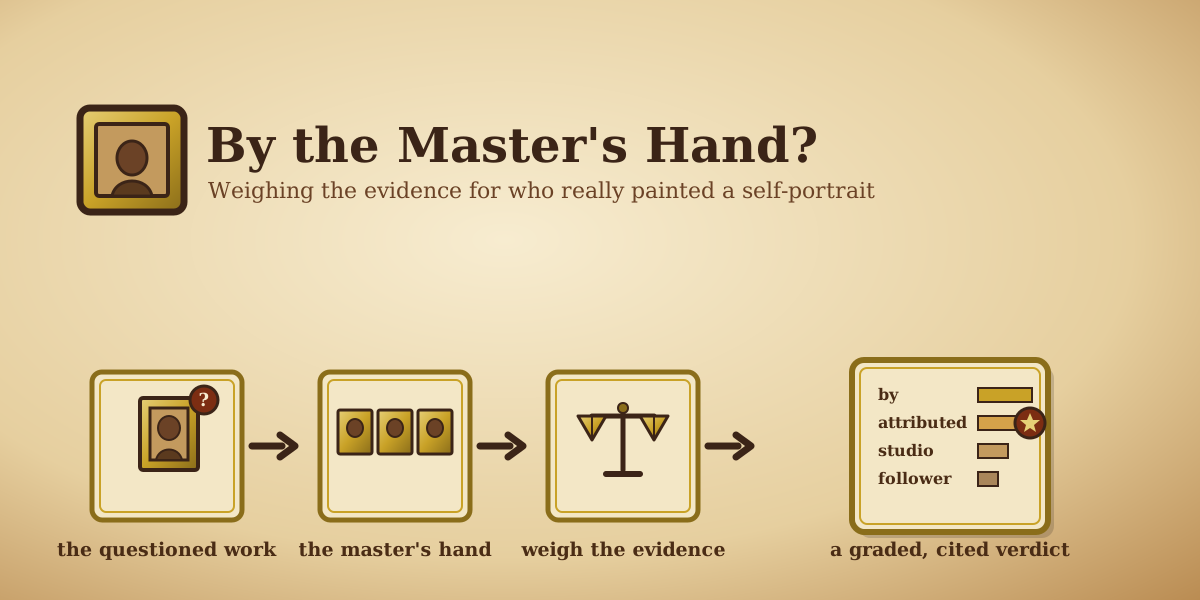
This thread builds an attribution 'second reader' for self-portraits: given a questioned work and an artist's confirmed corpus, it returns a graded, fully cited confidence assessment along the by / attributed-to / studio-of / follower-of ladder. It weighs several kinds of evidence — how consistent the work is with the artist's confirmed self-portraits, sitter/face consistency, and what the documented provenance and literature do and don't support — and combines them into a calibrated assessment that can abstain when the evidence isn't there, with every claim in the rationale traced to a source. It is framed strictly as decision support in a high-stakes, contested domain: the system drafts and evidences, a curator or expert decides, and it never issues an autonomous authenticity verdict. It builds on the lab's earlier self-portrait feature work, recast here as verification, and draws on computer-vision verification, retrieval-grounded provenance analysis, and calibrated, abstaining prediction. Faculty-advised.